Part 2: Ser and Estar tips from a former Spanish teacher

The present progressive and perfect tense are two somewhat more complex sentences using Ser and Estar for many native English speakers. That’s because these sentences use “to be” as gerunds and participles in addition to simple verbs. Although we often use these sentences in English, we rarely think about what we say as explicitly as we do in a foreign language. In addition, choosing between ser and estar adds an extra element of complexity.
Here, you’ll find concise explanations of the present progressive and perfect tense in English, followed by a description of their formation in Spanish and when to use ser or estar.
A Brief Review: To Be, Ser, and Estar
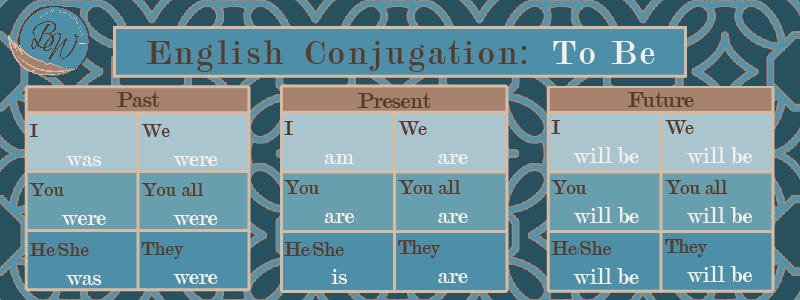
While English has only one “be” verb, Spanish has two, Ser and Estar. Each of these is used in distinct ways to express the many phrases and concepts translated as conjugations* of “be” in English. (Found in the tables above.)
*conjugations are variations of the verb depending on the subject or tense. For Example: I am, You are, We were
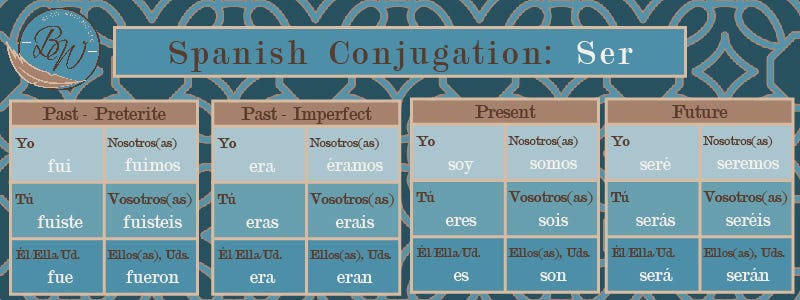
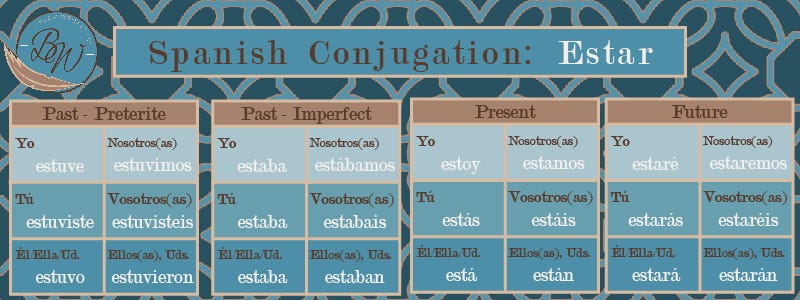
Learning the conjugations of ser and estar, found above, is only half the battle. The next step is knowing when to use ser and when to use estar, depending on what you are trying to communicate.
If you haven’t already, check out this article to learn the rules for choosing between them.
The Present Progressive
In English
In Engish, we use the gerund of a verb in the present progress. The gerund of a verb is easy to spot because it ends in -ing.
The gerund and conjugation of “to be” form the present progressive tense, which describes an ongoing action happening right now.
Here is the pattern:
Conjugation of be + gerund (verb ending in -ing)
Take a look at these examples:
- He is studying.
- Form of to be: is
- Gerund: studying
2. They were cooking.
- Form of to be: were
- Gerund: cooking
You can even “to be” twice in the present progressive using the gerund “being.”
Example:
You are being very annoying today.
- Form of to be: are
- Gerund: being
In Spanish
The present progressive in Spanish follows this pattern:
Conjugation of estar + Gerund
The verb estar, not ser, is always the “to be” verb used as the first verb in the present progressive in Spanish. Similar to how the English gerunds end in -ing, Spanish gerunds end in -ando or -iendo.
Examples:
- Ellos están edtudiando. — They are studying.
- Yo estoy corriendo. — I am running.
- Él está abriendo la puerta. — He is opening the door.
Ser
The gerund of ser is siendo.
In English, siendo is translated as “being.” In the present progressive, siendo will always be followed by a description of how someone or something is “being.”
- Estás siendo un buen estudiante. — You are being a good student.
Estar
In the present progressive, you will never use the gerund of estar, estando, because you are stating how someone or something is or was “being.” This implies an adjective (describing word) must follow, not a verb (action word). And descriptions, as you may recall from the article explaining the uses of ser and estar, use ser.
The Perfect Tense
In English
The perfect tense uses the past participle (been) after the auxiliary verb “have,” “has,” or “had” to describe ongoing actions from the past that may or may not still be happening.
Here are some examples that use the past participle of to be “been”:
- I have been stressed all week.
- Form of to have: have
- Past Participle: been
2. She has been an excellent student all year.
- Form of to have: has
- Past Participle: been
In Spanish
Here is the pattern for the perfect tense in Spanish:
Conjugation of haber + past participle
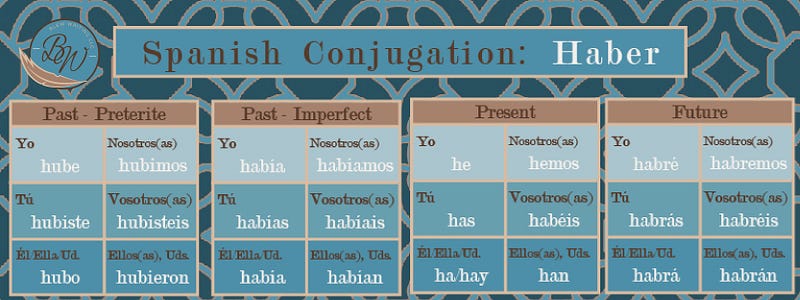
The perfect tense is formed much the same way in Spanish as it is in English. In Spanish, the auxiliary verb haber can be translated as the English “have,” “has,” or “had.”
The past participle in Spanish typically ends in -ado or -ido and is used to explain what someone or something “has done” or “has been.”
Examples:
- Yo he terminado. — I have finished.
- ¿Has vivido en Bogotá? — Have you lived in Bogotá?
- Nosotros hemos comido el almuerzo. — We have eaten the lunch.
Note: the Spanish auxiliary verb for “have” or “has in the perfect tense is haber. You can learn more about having, tener, and haber in the article below.
Ser
The past participle of ser is sido. It describes how someone or something “has been” in the past.
Tip: If the word or phrase that follows the past participle is an adjective, use sido.
Examples:
- Ella ha sido una amiga fiable. — She has been a reliable friend.
- Nosotros hemos sido triste. — We have been sad.
Estar
The past participle of estar is estado. Estado is the present participle when you say what someone or something “has been doing.”
Tip: If the word or phrase that follows the past participle is another verb, use estado.
Examples:
- Ellos han estado trabajando todo el día. — They have been working all day.
- Ella ha estado tocando el piano. — She has been playing the piano.
Conclusion
Once you understand the rules of ser and estar in the present progressive and perfect tense, it only takes a little practice and paying attention to how native speakers use them in conversation to become fluent in using them correctly.
I hope that you found this explanation useful. Feel free to leave follow-up questions in the comments.
 BLEW WRITING LLC