Haber, Tener, and more! Tips from a former Spanish teacher

Whether you’re an English speaker learning Spanish or a Spanish speaker learning English, the verb “to have” can be one of the trickiest to understand.
As a native English speaker who taught Spanish for seven years, I didn’t just have to learn this concept. I also had to be able to explain it and answer my students’ dozens of follow-up questions on it. So, I decided to share a brief explanation of some of the top reasons it can confuse language learners.
“Have” in English . . .

In English, we have two meanings for the verb “to have.” As native speakers, however, we don’t often think of it this way.
Possessive
If I ask you what “to have” means in English, the first and most common response is that it’s a verb used to show possession.
- I have 3 cookies.
- She has a glass of milk.
- We have a perfect snack.
Auxiliary
The second form of “to have” is an auxiliary verb to form the perfect tense.
- I have studied.
- She has been sleeping.
- They had played video games all afternoon.
What’s the difference in Spanish?
The problem for English speakers is that Spanish doesn’t use just one verb the way English does for these two distinctive expressions.
If you think about it, English could be much more precise if we used more specific verbs, as Spanish does. This lack of clarity isn’t only encountered with the verb “to have” either.
If you already know a bit of Spanish, then you’re probably familiar with “Ser and Estar.” Though they both translate to English as “to be,” they are used in very distinctive and different circumstances.
Like most writers, I am a big fan of using precise language. Just think of the language play that could exist if English used more specific verbs.
“Have” in Spanish . . .
Tener
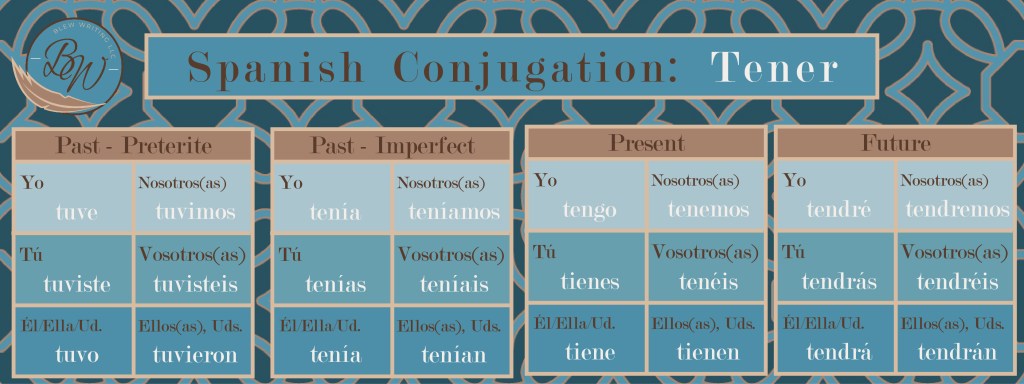
In Spanish, the “have” verb used to show possession is tener.
Tener is an irregular verb, which means it doesn’t follow the regular conjugation pattern for verbs that end in -er as you can see from the charts above, which include the most common conjugations.
Here are some examples of Spanish sentences using the verb tener to show possession:
- Tengo tres galletas. (I have 3 cookies.)
- Ella tiene una taza de leche. (She has a glass of milk.)
- Tenemos un bocado perfecto. (We have a perfect snack.)
Haber
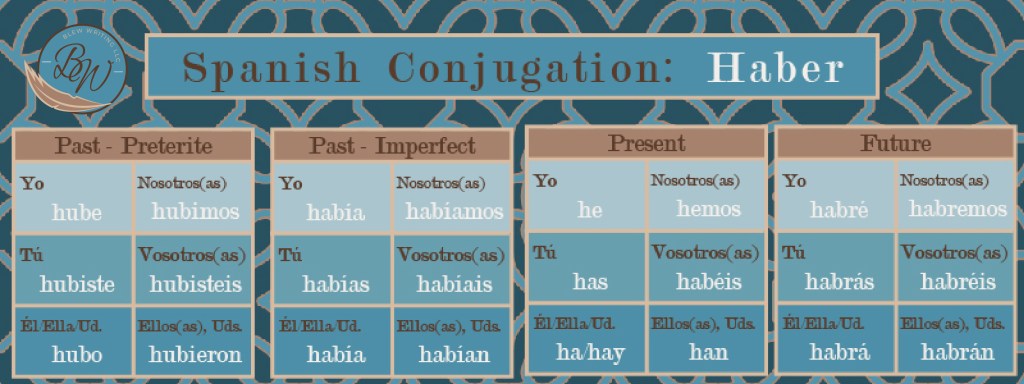
Haber is the Spanish auxiliary verb used to form the perfect tense in Spanish. To form the perfect tense, you use a conjugation of haber and the past participle of a verb. Past participles in Spanish typically end in –ado or –ido.
Here a few examples of sentences in the perfect tense that use the verb haber:
Here a few examples of sentences in the perfect tense that use the verb haber:
- He estudiado. (I have studied.)
- Ella ha estado durmiendo. (She has been sleeping.)
- Ellos habían jugado videojuegos por toda la tarde. (They had played video games all afternoon.)
To have or To be?
I have hunger. . . What????
This sentence is the literal translation of “tengo hambre” in English.
How we describe certain feelings or states of being in Spanish and English is another difference that causes problems for language learners.
In Spanish, a person “has feelings” as opposed to “being” in a state of feeling something.” An interesting distinction.
I’ve always found this distinction interesting because “having” a feeling instead of “being” it seems to imply an impermanence.
It’s like saying, “I am feeling jealous now, but I won’t be jealous forever.” It separates the feeling from the person, and that distance can help put the emotion or state into perspective.
Here are some examples of phrases that, in English, use the verb “to be” but in Spanish use “tener.”
- To be hungry/thirsty — Tener hambre/sed
- To be hot/cold — Tener frio/calor
- To be tired — Tener sueño
- To be lucky — Tener suerte
- To be jealous — Tener celos
- To be careful — Tener cuidado
You can check out a more extensive list in this article, Spanish Idioms that Use Tener.
Here are a few examples of how these look in context:
- ¡Ten cuidado, hijo! — Be careful, son!
- Tengo sed. ¿Tienes una botella de aqua? — I’m thirsty. Do you have a bottle of water?
- Él tiene muchos celos de sus otros amigos. — He is very jealous of her other friends.
- ¿Tienes frio? Tengo una chaqueta. — Are you cold? I have a jacket.
Tip: It may seem silly at first, but I found the best way to learn these phrases was to use literal translation. I normalized "I have thirst" or "I have sleepy." I would say them jokingly to my husband or students until they stopped sounding completely strange. This allowed me to more easily recall when a phrase used tener instead of ser or estar.
Whether you are an English speaker learning Spanish, a Spanish speaker learning English, or just a language nerd like myself who enjoys thinking about how the way we speak affects our thinking, I hope that this has helped clear up the differences between Spanish and English when it comes to the verb “have.”
 BLEW WRITING LLC