Linguistic observations during an international flight.
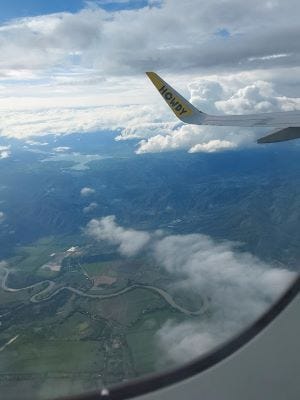
I’ve flown the route between Colombia and the United States many times, and I’m often struck by an odd sensation from nearly the moment I reach the check-in desk.
The airport is the place where linguistic worlds collide. It’s a place where everyone experiences the cognitive awareness of language use that bilingual speakers practice daily.
As a former foreign language teacher, I’m used to switching between the two frequently. I am not, however, accustomed to the world around me linguistically shifting over the duration of a short flight.
The United States speaks English.
Colombia speaks Spanish.
I speak both.
On a recent visit to the US, I was delighted to entertain myself by observing and analyzing this odd linguistic shift.
Entering the airport, I checked in with an attendant speaking Spanish at the desk.
I then chatted with the gentleman at Migration about visas and travel plans in Spanish.
The woman working the security checkpoint complemented my floral suitcase, and I thanked her in Spanish.
Suddenly, I’m in the terminal and ask the woman at the end of the line if they’re boarding zone one in Spanish, and she responds, “Si, una and two.”
A man joins the line behind me and asks in fluent, native English which zones are boarding. And I’m halfway through my response before I realize I’m not speaking English and correct myself.
In heavily accented English, the woman who checks my ticket asks if I speak Spanish. I respond that I do, and she seems relieved.
I’m surrounded, I realize, by a bilingual cacophony. All around me, people are having these same linguistically uncertain interactions.
As I listen, I hear codeswitching, sentences starting in one language and finishing in another. I note heavily accented Spanish and English as speakers try their best to communicate in foreign tongues. “¿Hablas?” and “Do you speak?” echo around me.
During the flight, it continues. Instructions and announcements come first in English, then repeat in Spanish.
Occasionally, one of the flight attendants calls on a bilingual co-worker to assist a traveler who doesn’t speak English.
Passengers interact with their neighbors in a mix of Spanish, English, and mime.
Some see it as overly difficult or unnecessarily complicated. “Why doesn’t everyone just learn English?” I’ve heard this question uttered by students more times than I care to recount.
But I love languages. I value the way they can influence thoughts and perceptions. In my view, this aviatic wormhole linking the Spanish and English-speaking worlds is one of the most interesting sociological observations I’ve witnessed when traveling.
There are lessons to be learned about life, empathy, communication, and consideration hiding in these uncertain interactions derived from the need to be understood.
Finally, we land, and as I exit the airport, I turn off the part of my brain that navigates the linguistic world. I’m headed for rural PA and won’t likely need it.
And sure enough, I don’t. And I feel a bit sad for the unfortunate mono-linguals, the lessons they’ll never learn, and the experiences they’ll never have because they couldn’t understand the language.
 BLEW WRITING LLC